Blog
There are plenty of gate companies out there — but very few that combine technical expertise, quality workmanship, and genuine customer care.
For modern businesses, protecting the property perimeter is just as important as securing the building itself. Warehouses, industrial facilities, office complexes, distribution centres, construction sites and commercial premises all experience regular movement of employees, visitors, suppliers and vehicles. Managing this movement efficiently while preventing unauthorised access can be a significant security challenge.
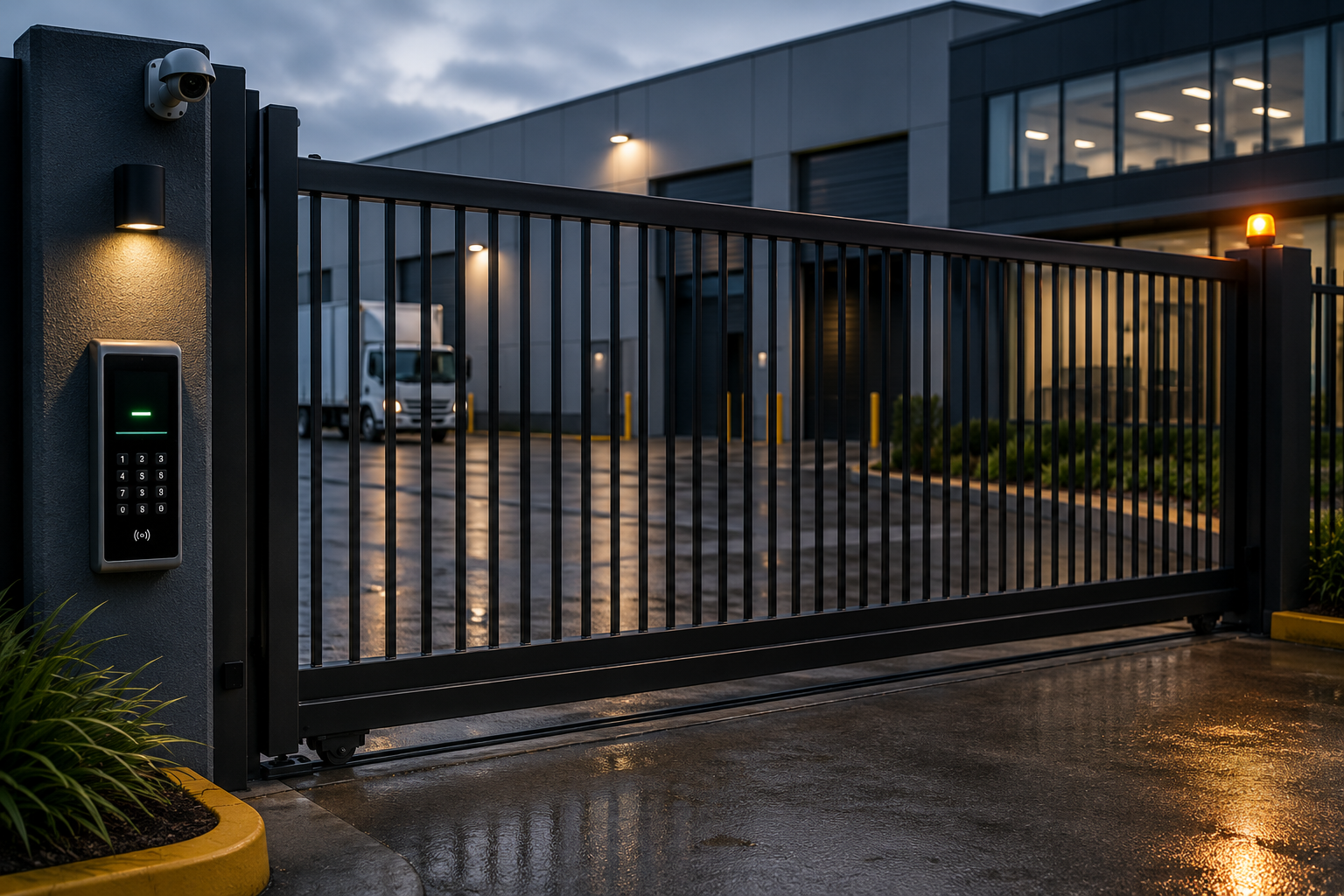
This is where commercial gate automation plays an increasingly important role. An automated commercial gate does much more than open and close an entrance. When professionally designed and integrated with appropriate access control technology, it becomes an essential part of a property’s overall security strategy.
Modern businesses are moving away from traditional manually operated gates and relying more heavily on automated systems that provide controlled entry, improved convenience and better oversight of who enters a property. Current industry guidance in New Zealand also emphasises that an effective automated gate solution should consider the entire site, including the gate, motor, safety equipment, access control and the way people and vehicles use the entrance.
In this guide, we explore how commercial gate automation improves business security and access control, the technologies involved and why it has become a valuable investment for commercial and industrial properties.
Every commercial property has a physical boundary, but that boundary is only effective when access points can be properly controlled. Driveways, vehicle entrances and service areas can otherwise become vulnerable points through which unauthorised people or vehicles may enter.
A professionally designed automated gate creates a physical barrier between the public and the business premises. Unlike a gate that is manually operated or regularly left open, an automated system can remain closed when the entrance is not actively being used.
This simple change can significantly improve perimeter security. The gate establishes a controlled entry point and requires authorised users to interact with an approved access method before entering the property.
For businesses with valuable equipment, vehicles, stock or sensitive information, commercial gate automation can therefore become an important part of a broader security strategy. It creates a clear separation between public areas and restricted business spaces.
One of the greatest advantages of automated gates is the ability to control exactly who can access a commercial site.
Traditional gates often depend on physical keys or manual supervision. This can create problems when businesses have multiple employees, contractors or visitors requiring access throughout the day.
Modern access control systems Auckland businesses can use with automated gates provide much greater flexibility. Depending on the requirements of the property, authorised users may gain entry through remote controls, keypads, access cards, fobs, mobile applications or other approved credentials.
Commercial access control technology allows businesses to establish rules around who is permitted to enter and, in more advanced systems, when that access is available. This gives property managers greater control than a conventional gate that relies on manual operation alone.
For example, employees may be granted regular access during working hours, while contractors or temporary visitors can be managed differently according to the needs of the business.
Security should protect a business without unnecessarily disrupting daily operations.
A commercial property may receive numerous employees, delivery vehicles, contractors and customers throughout the day. Requiring someone to manually open and close a heavy gate every time a vehicle arrives can slow down operations and create unnecessary inconvenience.
With commercial gate automation, authorised users can access the property quickly and efficiently. A properly configured system can open the gate when an approved credential is presented and secure the entrance again after the vehicle has entered.
This creates a better balance between security and convenience.
Warehouses and industrial facilities, for example, often require frequent vehicle access. An automated gate can help manage this movement while ensuring the property is not left unnecessarily exposed between arrivals.
Industry guidance also highlights the importance of selecting automation and access methods based on the traffic requirements and operating conditions of each site. The right system should support smooth daily movement while maintaining appropriate security controls.
Commercial properties rarely have only one type of visitor.
A business may need to provide access to employees, management teams, delivery drivers, suppliers, contractors, maintenance professionals and customers. Each group may require a different level of access.
This is where commercial gate automation becomes particularly valuable.
A modern automated system can be integrated with access control technology that allows businesses to manage different user groups more effectively. Employees may use a dedicated access credential, while visitors can request entry through an intercom or communication system.
This approach helps businesses maintain a more organised entrance while reducing the need for unrestricted access.
Rather than treating every visitor in exactly the same way, the property can establish a more structured entry process. This improves both operational efficiency and security awareness.
Many commercial and industrial properties are not occupied continuously. Offices may close overnight, warehouses may have limited after-hours staffing and industrial sites may remain largely unattended outside operating hours.
An open or poorly secured entrance can create an obvious vulnerability during these periods.
Security gates Auckland businesses install with automated technology can help maintain protection around the clock. The gate can remain securely closed outside approved access periods while authorised personnel can still enter using their designated credentials.
This is particularly useful for businesses with shift workers or emergency access requirements.
An automated system also removes the need for employees to physically handle a heavy gate late at night or during poor weather conditions. The entrance can be operated from an appropriate access device, reducing inconvenience while maintaining controlled entry.
The true value of commercial gate automation becomes even greater when the gate is integrated with a wider security system.
An automated gate can work alongside:
These technologies can create a more connected approach to commercial property security.
For example, a visitor may arrive at the entrance and use an intercom system to request access. Authorised personnel can then verify the visitor before allowing the gate to open. A CCTV camera can provide additional visibility of the entrance and surrounding area.
Modern access control platforms are increasingly designed to integrate multiple security functions and manage access through a combination of hardware, credentials and software.
For Auckland businesses, combining gate automation Auckland solutions with appropriate access control technology can provide a more comprehensive approach to managing property entry.
One challenge for large commercial sites is understanding who is entering and leaving the property.
Traditional keys can be copied, lost or shared. Once a key has been distributed, a business may have limited visibility over how it is being used.
Electronic access control provides a more structured alternative. Depending on the system configuration, businesses may be able to manage individual credentials and review access activity.
This can improve accountability across the property.
If an employee leaves the business or a contractor no longer requires access, electronic credentials can potentially be updated or removed without physically replacing every lock or issuing new keys. This makes access management more efficient for organisations with changing staff and visitor requirements.
The ability to manage access more effectively is one reason access control Auckland solutions have become increasingly relevant to commercial security planning.
Commercial properties often store valuable assets outside the main building.
Company vehicles, machinery, tools, trailers and other equipment may be located within outdoor yards or parking areas. Without effective perimeter security, these assets can become more vulnerable to theft or unauthorised access.
An automated commercial gate creates an additional layer of protection around these areas.
When combined with fencing, lighting and CCTV, automated security gates can contribute to a stronger perimeter security strategy. The gate does not work in isolation. Instead, it becomes part of a layered approach that makes unauthorised access more difficult.
A visible and professionally installed security gate can also act as a deterrent. A property with clear access restrictions and controlled entry presents a more challenging environment for unauthorised visitors.
Not every commercial property requires the same gate design.
The most suitable commercial gate automation system depends on the available space, traffic volume, security requirements and physical characteristics of the site.
Sliding gates are often popular where space behind or in front of the entrance is limited. They can provide a strong and practical solution for industrial properties and commercial facilities.
Swing gates may suit properties with sufficient clearance and can offer an attractive solution for certain business premises.
Cantilever gates are another option for commercial and industrial environments, particularly where avoiding a ground track is beneficial.
Site layout is an important consideration when selecting a gate style. Factors such as slopes, available operating space and traffic requirements can influence whether a sliding, swing or alternative gate configuration is most appropriate.
A professional site assessment helps ensure the gate design and automation equipment are appropriate for the property.
Commercial automated gates are large, heavy and frequently used pieces of equipment. As a result, safety must always be considered alongside security.
A gate should not simply be fast and powerful. It must also operate safely around employees, visitors, pedestrians and vehicles.
Important safety technology may include obstacle detection, photoelectric safety beams, warning devices and appropriately configured emergency release systems.
WorkSafe New Zealand has specifically highlighted the potential hazards associated with automated gates and the importance of appropriate safety measures, risk assessment and maintenance.
Businesses should therefore work with experienced professionals when installing or upgrading commercial gate automation systems. Correct design, installation and ongoing maintenance are essential to maintaining both reliable operation and a safe environment.
Manual security processes can be difficult to manage consistently.
A gate may be accidentally left open, an employee may forget to secure the entrance or staff may need to interrupt their work to provide access to visitors.
Automation reduces some of these operational challenges.
Once configured correctly, the gate can follow a consistent operating process. Authorised users can enter through approved access methods, while the system can help ensure the entrance is secured after use.
This can reduce the likelihood of human error while making access management more efficient.
For busy commercial sites, this consistency can be particularly valuable.
A small business may initially have simple access requirements. However, as the organisation grows, it may employ more staff, operate longer hours or receive a greater number of visitors and deliveries.
A scalable commercial gate automation solution can adapt to these changing requirements.
Businesses may begin with a basic automated gate and remote access system before introducing additional access control features as their security needs develop.
This flexibility allows commercial properties to invest in security infrastructure that can support their future requirements rather than relying entirely on a short-term solution.
A malfunctioning commercial entrance can quickly affect business operations.
Delivery vehicles may be unable to enter, employees may experience delays and security can be compromised if the gate cannot close properly.
Regular maintenance is therefore essential.
Commercial gate systems should be inspected and maintained according to their level of use and operating environment. High-traffic properties place greater pressure on motors, rollers, sensors and other mechanical components.
Professional maintenance can identify potential problems before they develop into major failures. Industry safety guidance also stresses the importance of keeping automated gates in safe working condition and testing their safety features regularly.
Investing in maintenance helps protect the business from unexpected disruption while extending the working life of the gate system.
The effectiveness of a commercial automated gate depends heavily on how well the entire system is designed and installed.
The gate itself is only one part of the solution. The automation motor must be suitable for the size and weight of the gate. The access control system must meet the requirements of the users. Safety devices must be correctly installed and configured.
A professional installation process considers the complete site.
This includes traffic flow, gate usage, vehicle types, power requirements, safety risks and future access requirements. Industry experts consistently emphasise that an effective automated gate solution requires more than simply attaching a motor to an existing gate.
For businesses looking for long-term reliability, a professionally planned system is an important investment.
Commercial gate automation has become an essential security solution for businesses that need to control vehicle and pedestrian access without compromising operational efficiency.
An automated gate creates a strong physical barrier while allowing authorised employees, contractors and visitors to enter through controlled access methods. When integrated with modern access control technology, CCTV and communication systems, it can become an important part of a comprehensive commercial security strategy.
For warehouses, industrial facilities, office buildings and other commercial properties, the benefits extend beyond convenience. Commercial gate automation can improve perimeter security, support better access management, protect valuable assets and create a more efficient entry process.
The key is selecting a solution that matches the specific requirements of the property. The right gate design, automation equipment, access technology and safety features should all work together to provide reliable long-term performance.
For businesses in Auckland, investing in professionally designed commercial gate automation can provide greater control over property access while helping create a safer and more secure business environment.