Blog
There are plenty of gate companies out there — but very few that combine technical expertise, quality workmanship, and genuine customer care.
West Auckland has a character unlike most of the city. Drive twenty minutes past Henderson and you’re in lifestyle block and rural territory, Kumeu, Huapai, Riverhead, Waimauku, Muriwai, and out toward Helensville, where properties sit on acres rather than sections, driveways stretch well beyond a standard suburban length, and the nearest neighbour might be out of sight entirely. Gate automation on these properties has to solve different problems than it does on a quarter acre suburban block, and property owners out this way often assume automation isn’t practical for them when, in most cases, it’s exactly the kind of property that benefits most.
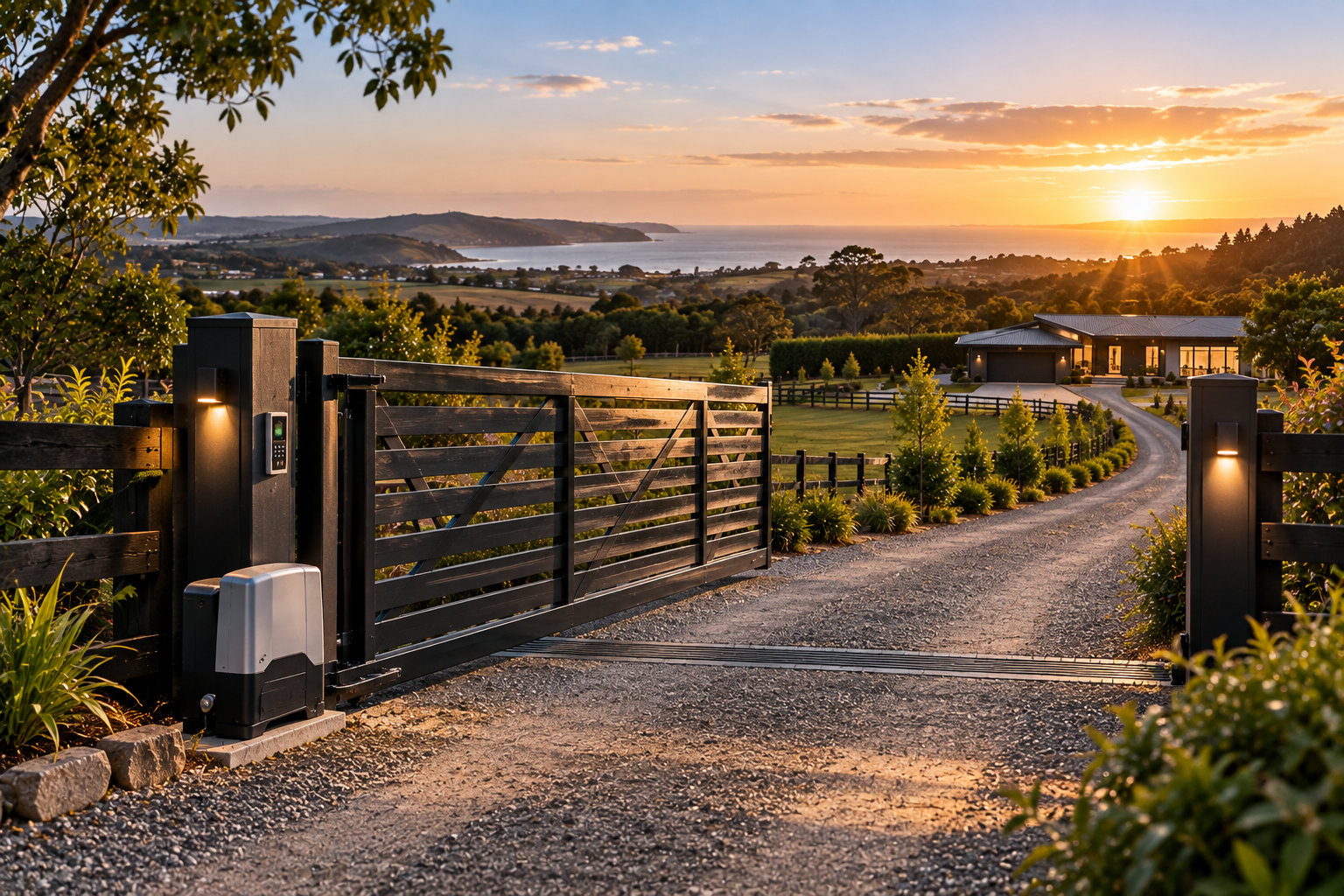
A standard suburban gate automation job involves a short driveway, easy access to mains power, and a gate that gets used several times a day by the same one or two vehicles. A lifestyle block out in West Auckland is often the opposite on every count. Driveways can run fifty metres or more from the road, power isn’t always close to the gate location, the terrain might slope or be unsealed, and the property might be exposed to weather coming straight off the Tasman near Muriwai and the west coast. None of this makes automation harder in a way that matters, it just means the system has to be specified for the actual site rather than treated as a standard suburban install.
Ask most lifestyle block owners why they automated their gate and the answer usually isn’t security first, it’s the daily reality of getting in and out. Stepping out of the car to manually open a gate in the rain, at night, with groceries in the back seat or kids waiting to get home, is a different experience on a property with a long gravel driveway than it is on a short urban one. Automatic gates remove that entirely, you trigger it from the car and drive straight through. On properties where the gate sits well back from the house, this convenience factor alone is often worth more to owners than the security benefit, even though both matter.
The choice between a sliding and a swing gate often comes down to the driveway itself rather than preference. Long, straight driveways with enough clearance to the side usually suit sliding gates well, since the gate panel runs along a track beside the driveway rather than needing room to swing open. Properties with sloped entrances or limited side clearance, which is common on West Auckland’s hillier blocks, often suit a swing gate better instead. The right answer depends on the actual entrance, which is why a site visit matters more here than it might on a flat suburban section.
One of the most common questions from lifestyle block owners is what happens when the gate is too far from the house or the property boundary to run mains power to it easily. This is a genuine consideration on rural sites, and it’s one of the first things worth raising during a site assessment, since trenching power out to a gate fifty or more metres from the nearest supply adds real cost to a project. Solar powered gate systems are a practical option in this situation, since the motor and control system run off a battery charged by a small solar panel at the gate itself, removing the need to run power out at all. This is particularly relevant for properties further out toward Waimauku and Helensville, where the gate is often a genuine distance from the house.
Security looks different on an isolated lifestyle block than it does on a suburban street. There’s no row of neighbouring houses watching the driveway, and if something happens, response times from emergency services can be longer simply because of the distance involved. A gate that’s left open out of convenience defeats a lot of its own purpose, which is why pairing automation with a proper access control system, like a keypad, intercom, or app controlled entry, matters more here than it might closer to town. It means the gate can stay closed by default, with entry managed deliberately rather than left open because walking down to it every time is impractical.
West Auckland’s rural fringe takes more weather than the city does, particularly out toward the coast. Wind, rain, and salt air around Muriwai and the west coast properties put more strain on gate hardware over time than a sheltered urban install sees. This affects the choice of materials and motor, and it’s part of why a system specified for a coastal or exposed rural site should account for that exposure from the start rather than using the same setup that would suit a sheltered suburban driveway. Unsealed or gravel driveways also affect gate and track design, since a sliding gate track needs a stable, level base to run smoothly over time.
For properties with paddocks, larger boundaries, or stock to manage, electric fencing often comes into the conversation alongside gate automation, and this is actually where electric security fencing tends to make the most sense, rural and lifestyle block boundaries set well back from any public footpath or street frontage. Pairing a secured gate entrance with a properly installed electric boundary fence gives a lifestyle block genuine perimeter security rather than just a controlled driveway, which matters on larger properties where the gate is only one part of the boundary.
Rural gates tend to be larger and heavier than standard suburban gates, often built from solid timber or steel to match the property’s style and to hold up to the exposure they face. This matters for motor selection, since a motor sized for a lightweight suburban gate won’t hold up under the load of a heavier rural gate used daily. Getting the motor sizing right from the start avoids premature wear and the kind of recurring breakdowns that happen when a system is underspecified for the gate it’s actually moving.
Rural and lifestyle block gates often cycle less frequently than a busy commercial or suburban gate, sometimes just a handful of times a day, but they’re exposed to harsher conditions for longer stretches between use. That combination, lower cycle count but higher weather exposure, means maintenance priorities are a little different out here. Regular checks on sensors, track alignment, and weatherproofing matter more than high cycle wear and tear does. A proper service plan through ongoing maintenance keeps the system reliable, which matters even more on an isolated property where a gate stuck open or shut isn’t something you can easily work around until a technician arrives.
Every lifestyle block is different, driveway length, terrain, power access, and what the gate actually needs to protect all vary from one West Auckland property to the next. The honest starting point is a site visit, since the right combination of gate type, power source, and access control genuinely depends on the specifics of the property rather than a one size fits all recommendation. If you’re out in Kumeu, Huapai, Riverhead, Waimauku, Muriwai, or further toward Helensville and weighing up automation for your driveway, a free site assessment is the most reliable way to get an honest answer on what will actually work for your property.
Q1. Can gate automation work on a property with no easy access to mains power?
Yes. Solar powered gate systems run off a battery charged by a small panel at the gate, which removes the need to trench power out to a remote entrance. This is a common solution for lifestyle blocks where the gate sits well back from the house.
Q2. Should I choose a sliding or swing gate for a rural driveway?
It depends on the driveway itself. Long, straight driveways with side clearance usually suit sliding gates, while sloped or narrower entrances often suit a swing gate better. A site visit is the best way to confirm which fits your specific entrance.
Q3. Does a heavier rural gate need a different motor to a standard suburban gate?
Yes. Rural gates are often larger and heavier, built from solid timber or steel, and need a motor sized for that load. Underspecifying the motor leads to premature wear and more frequent breakdowns.
Q4. Is gate automation worth it if the gate isn’t used very often?
Yes, particularly on isolated properties. Even with lower daily use, the convenience of not manually opening a gate in poor weather, along with the security of keeping the entrance closed by default, makes automation worthwhile regardless of cycle count.
Q5. Can electric fencing be added alongside an automated gate on a lifestyle block?
Yes. Larger rural boundaries with paddocks or stock often pair well with electric fencing alongside a secured gate entrance, giving the property genuine perimeter security rather than just a controlled driveway.
Q6. How does weather exposure affect gate automation on West Auckland’s coastal and rural properties?
Wind, rain, and salt air put more strain on gate hardware over time, particularly near the coast around Muriwai. Systems on exposed sites should be specified with that exposure in mind, including material choice and regular maintenance checks.