Blog
There are plenty of gate companies out there — but very few that combine technical expertise, quality workmanship, and genuine customer care.
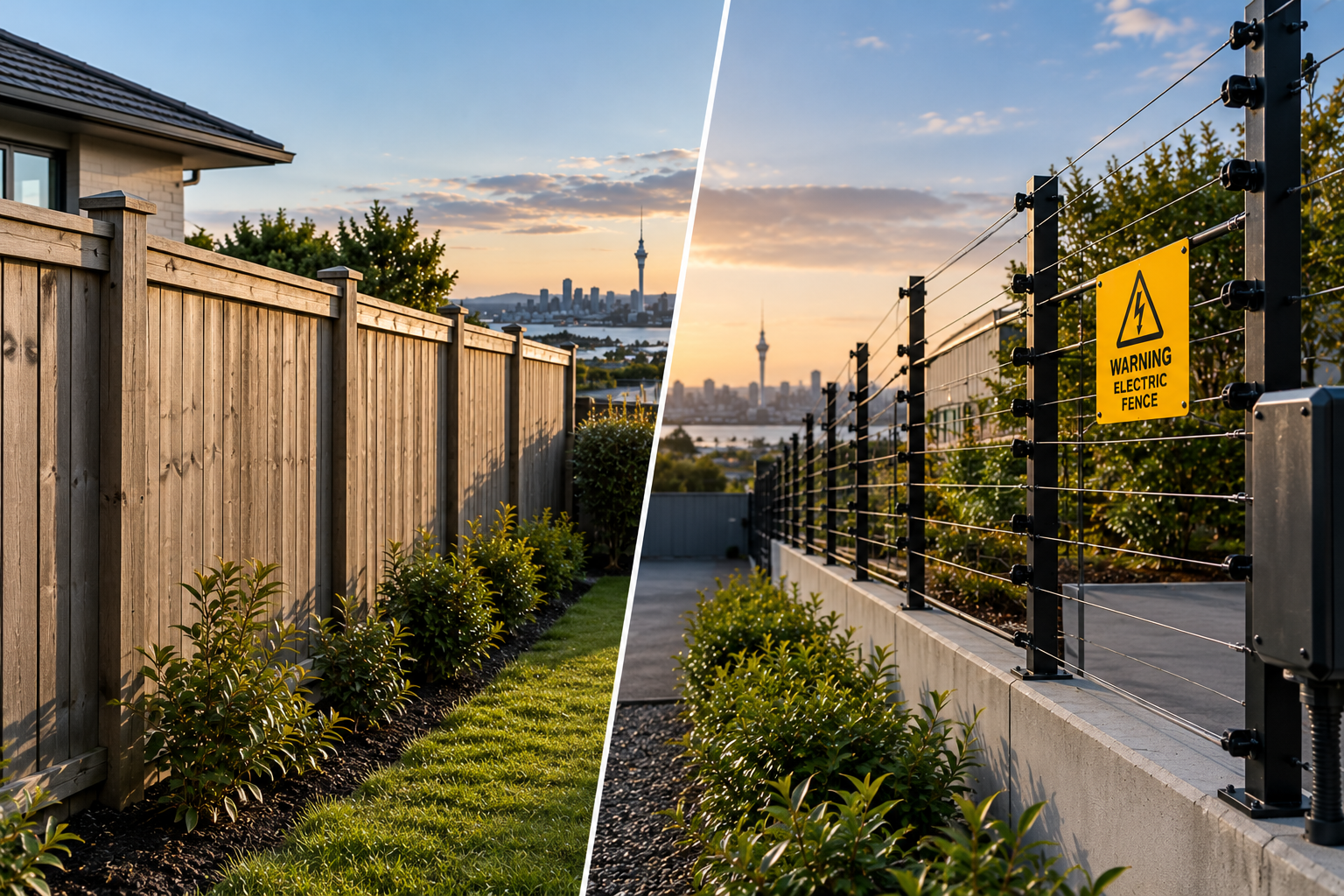
When you want to secure a property, the fence is usually the first thing you think about. For most Auckland homes and businesses, that means a timber fence, steel mesh, palisade, or a masonry wall. These are familiar, and for general boundary marking they do the job. But as security concerns grow, more property owners are asking whether electric fencing offers something a traditional fence cannot. The honest answer is that they do different jobs. This guide compares them on the points that matter for security, so you can decide what your property actually needs.
Traditional fencing, whether timber, mesh, palisade, or a solid wall, has been the default boundary solution for a long time, and for good reasons. It is a visible, physical barrier that marks where your property ends. It provides privacy, keeps children and pets in, keeps animals out, and gives a property a finished look.
For many suburban sections, a well built traditional fence is all that is needed. It also has no moving parts or power requirements, so there is very little to go wrong. If your main goal is privacy and boundary definition, traditional fencing is a sensible and familiar choice.
The limitation of a traditional fence is that it is passive. It stands there and relies entirely on being difficult to climb, cut, or break through. It does nothing to tell you that someone is trying.
A determined intruder can spend time climbing, cutting, or forcing a standard fence, and unless someone happens to be watching, nobody knows until the damage is done. A solid timber fence can also work against you, because it hides anyone who is on the other side of it from neighbours and passers-by. For properties with valuable stock, equipment, or vehicles, a fence that only physically blocks without alerting anyone leaves a gap in your security.
Electric security fencing is built on a different idea. Rather than relying only on being a physical obstacle, it is designed to deter and to detect. A fence line that is monitored can alert you when someone touches, cuts, or tampers with it. EzyGate’s electric security fencing includes integrated intrusion detection that provides alerts when a fence line is compromised.
That alert is the key difference. Instead of discovering a breach the next morning, you can know about it as it happens. For businesses, warehouses, and larger properties, that earlier warning is often what makes the difference between a close call and a loss.
A traditional fence deters mainly by being awkward to get over. An electric fence sends a much clearer message. Warning signs and the visible presence of an electrified perimeter make it plain that the property is actively protected. For many would-be intruders, that is enough to move on to an easier target.
This deterrent effect matters because the best security outcome is the attempt that never happens. A property that looks hard to approach and likely to raise an alarm is far less attractive than one with an ordinary fence that can be climbed quietly in the dark.
The other major difference is what happens after someone attempts to breach the perimeter. With traditional fencing, response depends on someone noticing. With a monitored electric fence, the system can notify you or a monitoring service that something has happened at a particular part of the fence.
That information is valuable. It lets you check cameras, call for help, or send someone to investigate straight away. It also means a failed attempt is something you know about, rather than something you only find out about when you see damage later.
It is a common misunderstanding that you have to choose between electric and traditional fencing. In many cases, electric security systems can be added to a fence you already have. EzyGate can integrate electric security systems with suitable existing fencing structures, which means your current boundary can become the base for a stronger security layer rather than something you throw away.
This is often the most practical route. Keep the fence that gives you privacy and boundary definition, and add the electric component that gives you deterrence and detection. Whether your existing fence is suitable depends on its condition, height, and construction, and this is something to check during a site assessment.
| Factor | Traditional Fencing | Electric Security Fencing |
|---|---|---|
| Physical barrier | Yes | Yes, when combined with a fence structure |
| Active deterrent | Limited | Strong, visible and designed to deter |
| Detects attempts | No | Yes, with intrusion detection |
| Alerts you | No | Yes, when integrated with alerts or monitoring |
| Privacy | Good, especially solid fences | Depends on the fence it is built on |
| Moving parts or power | None | Requires power and regular checks |
| Best suited to | Boundary marking, privacy, general use | Higher risk sites, commercial and industrial properties |
Electric security fencing is not necessary for every property, and it is worth being honest about that. It tends to make the most sense where the risk and the value of what is being protected are higher.
For a typical suburban home with a modest boundary, a good traditional fence combined with sensible lighting and locks may be enough. The right choice depends on what is at stake and how likely a break-in attempt is.
The strongest security rarely relies on one thing. A fence on its own, electric or not, is one layer. Combined with other measures, it becomes part of a system that is much harder to beat.
EzyGate’s electric fencing can be combined with alarms, CCTV, and access control for more complete protection. A monitored fence that triggers cameras and alerts, backed by controlled entry through automatic gates and a properly managed access control system, gives you several chances to deter, detect, and respond. For business sites, this is often paired with commercial gate systems at the main entrance so that the whole perimeter is covered, not just the fence line.
Traditional fencing is usually simpler to maintain. Once it is built, it mainly needs occasional repairs, painting, or replacement of damaged sections. Electric fencing involves powered equipment, so it needs regular checks to stay reliable. Energisers, wiring, and monitoring equipment should be inspected, and vegetation or damage along the fence line can affect performance.
This is not a reason to avoid electric fencing, but it is a reason to plan for it. EzyGate services existing electric fencing installations, including maintenance, repairs, upgrades, and troubleshooting, and a regular maintenance and servicing plan helps keep the system working as intended. Costs depend on the length of the fence, the site, and the features you choose, so a site assessment is the best way to get an accurate picture.
Electric fencing has to be installed properly to be safe and compliant. That includes correct equipment, appropriate warning signs, and installation by trained people. A poorly installed electric fence is a risk to everyone, including you. This is one of the strongest arguments for using professional installers rather than treating it as a do it yourself project. Compliance rules also affect where an electric fence can go, particularly near public boundaries, so it is worth confirming what applies to your site before deciding on a layout.
A few questions can help you decide.
If the answers point to higher risk or higher value, adding electric security to your perimeter is worth serious consideration. If not, a well maintained traditional fence may be all you need. A site assessment can help you work out where your property sits between the two.
Q1. Is electric fencing more secure than a traditional fence?
They do different jobs. A traditional fence is a passive physical barrier. An electric security fence adds deterrence and, with intrusion detection, can alert you when someone tampers with the fence line. For higher risk sites, that added detection is the main security advantage.
Q2. Can I add electric fencing to my existing fence?
In many cases, yes. Electric security systems can be integrated with suitable existing fencing structures. Whether your fence is suitable depends on its condition, height, and construction, which would be checked during a site assessment.
Q3. Does electric fencing replace the need for CCTV or alarms?
No. Electric fencing works best as one layer in a wider security setup. It can be combined with alarms, CCTV, and access control, so that an alert at the fence line can be backed up by cameras and a response plan.
Q4. Is electric fencing suitable for a normal suburban home?
It depends on the property and the level of risk. Electric fencing is more common on commercial, industrial, and larger properties. For a typical suburban section, a good traditional fence with lighting and locks is often enough, and local rules affect where electric fencing can be used near public boundaries.
Q5. Does an electric fence need regular maintenance?
Yes. Because it uses powered equipment, it should be inspected regularly. Energisers, wiring, and monitoring equipment need checking, and damage or growth along the fence line can affect performance. Regular servicing helps keep the system reliable.
Q6. Does EzyGate install traditional fencing as well?
EzyGate focuses on electric security fencing, gates, access control, and related systems. If you already have a suitable fence, EzyGate can add an electric security system to it, and can service existing electric fencing installations.