Blog
There are plenty of gate companies out there — but very few that combine technical expertise, quality workmanship, and genuine customer care.
If you’re planning access control for a car park, driveway, or commercial yard in Auckland, one of the first decisions you’ll face is whether a barrier arm or a full automatic gate is the right fit. Both control who comes in and out of a property, but they do it in very different ways, and choosing the wrong one can mean paying for security features you don’t need, or worse, not getting the protection your property actually requires.
At EzyGate, we get asked this question constantly by property managers, business owners, and body corporate committees across Auckland. This guide breaks down the real differences so you can make a decision based on how your site actually works, not just what looks good.
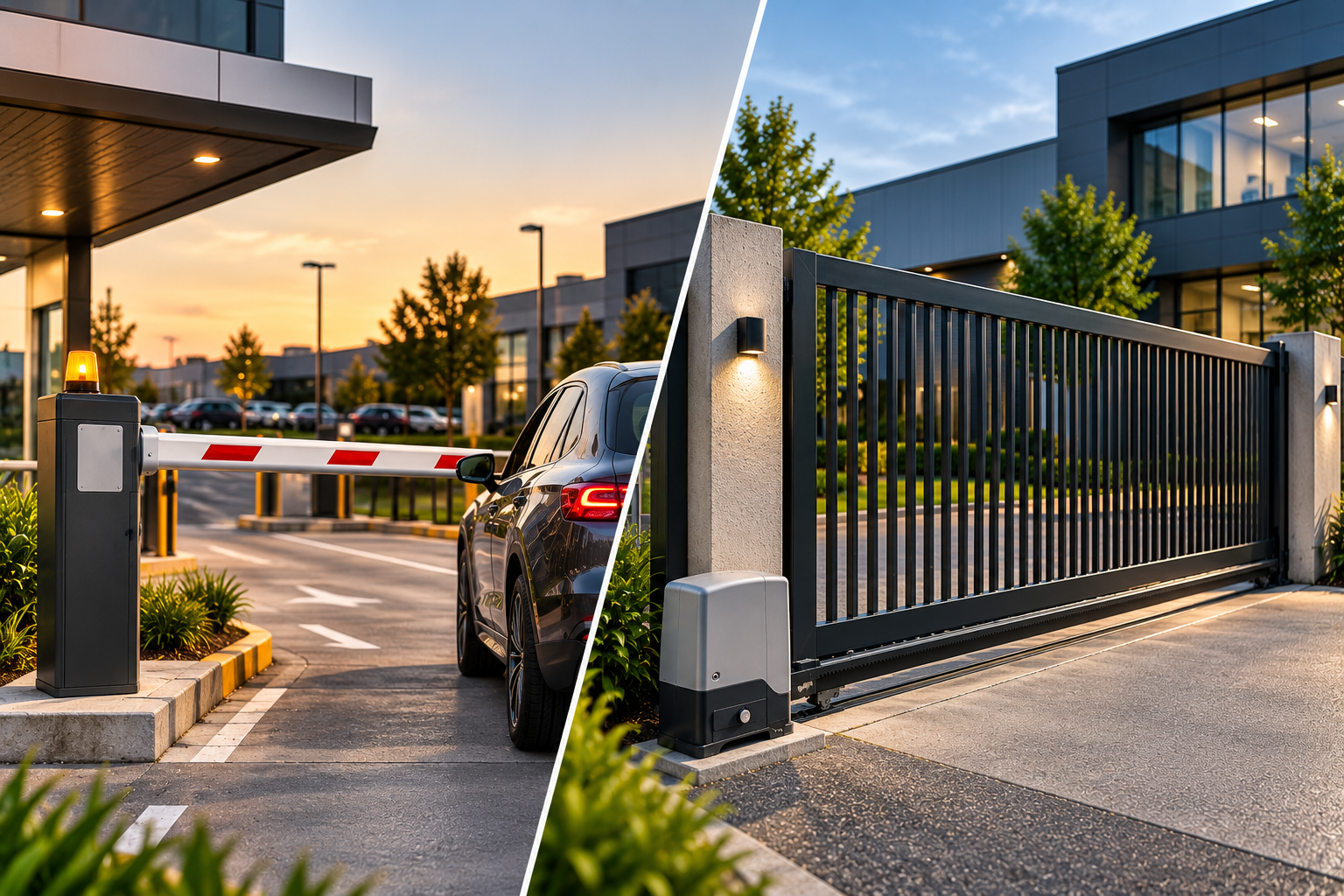
A barrier arm is a long pivoting pole, usually aluminium or steel, mounted on a post beside the entry lane. When triggered, the arm lifts up and out of the way, then lowers again once the vehicle has passed through. You’ll see these at carpark buildings, toll booths, and gated commercial sites where vehicles need to be managed quickly and in high volume.
Barrier arms are built for one job: controlling vehicle flow. They don’t offer a physical barrier against pedestrians walking around the side, and they’re not designed to stop a determined intruder. What they do very well is manage traffic quickly, cheaply, and with minimal footprint, which is why barrier arm installation is so common across Auckland’s car park buildings and retail centres.
An automatic gate is a full physical barrier, sliding or swinging, that closes off the entire width of an entrance. Unlike a barrier arm, a gate provides genuine perimeter security. Nobody is walking around it, climbing over the side, or driving a vehicle through a gap, because there isn’t one.
EzyGate installs both sliding and swing automatic gates in Auckland, and the choice between them usually comes down to the driveway itself. Sliding gates work well on sloped or narrow driveways where a swing gate wouldn’t have room to open, while swing gates suit flatter sites with enough clearance in front of the entrance.
The simplest way to think about it: a barrier arm manages traffic, an automatic gate secures a perimeter.
If your main concern is speeding up entry and exit for a high volume of vehicles, like a retail car park or a staff parking area, a barrier arm is usually the more practical and cost-effective choice. If your main concern is stopping unauthorised access entirely, whether that’s vehicles, pedestrians, or after-hours intrusion, an automatic gate is the system actually built for that job.
| Feature | Barrier Arm | Automatic Gate |
|---|---|---|
| Primary purpose | Traffic flow control | Full perimeter security |
| Blocks pedestrians | No | Yes |
| Typical use case | Car parks, toll lanes, staff parking | Driveways, commercial yards, industrial sites |
| Install cost | Generally lower | Varies by size and gate type |
| Visual appearance | Functional, utilitarian | Can be styled to suit the property |
| Speed of operation | Fast, built for high traffic volume | Fast, but gate size affects cycle time |
A barrier arm is usually the right call when:
This is why barrier arms are used so often in multi-tenant car park buildings and retail centres. They’re not trying to be a security wall, they’re trying to keep traffic moving in an organised way.
An automatic gate is the better fit when:
For commercial and industrial sites specifically, this is almost always the right direction. Most of the commercial gate systems we install are for exactly this reason, warehouses, factories, and multi-gate sites that need real perimeter control, not just traffic management.
Both systems need to be installed with safety in mind, but the risks are different.
Barrier arms need photoelectric safety sensors to detect vehicles or obstacles in the arm’s path, and the arm itself should be designed to stop safely if struck. Since barrier arms operate in lanes with constant traffic, response time and sensor reliability matter a lot.
Automatic gates need safety edges, photo beams, and often loop detectors, since a moving gate panel carries more force and a larger moving mass than a barrier arm. This is especially important on properties where pedestrians or children might be nearby. Every EzyGate installation includes the safety sensors required to meet New Zealand safety standards, regardless of which system you choose.
Yes, and on larger commercial sites this is actually common. A property might use an automatic gate for the main perimeter entrance, securing the site after hours, and a barrier arm inside the compound to manage internal traffic flow between zones, like separating visitor parking from a loading dock.
On larger sites, barrier arms and gates are often paired with access control systems like keypads, intercoms, or card readers, so you’re managing who can trigger them in the first place, not just the hardware itself.
This is an underrated factor. A barrier arm looks exactly like what it is: functional, industrial, built for a job. That’s fine for a parking structure, but it’s not going to do much for the street presence of a business or a residential property.
An automatic gate, on the other hand, can be styled to match the property, timber look panels, powder coated steel, or a clean minimal design, while still doing the security job. If the entrance to your site is also the first thing clients or visitors see, this is worth factoring into the decision alongside the security requirement.
Barrier arms are generally the lower cost option upfront, since the hardware is simpler and installation is usually quicker. Automatic gates vary more in price depending on the size of the opening, the gate material, and whether it’s a sliding or swing system, but they also do more: full security, and a stronger deterrent effect.
Rather than estimating costs from a guide like this, the most accurate way to get a number for your specific site is a free, no obligation site assessment. Every project is different depending on ground conditions, power access, and the size of the opening, so we’d rather give you an honest figure based on your actual property than a generic estimate that doesn’t hold up.
Barrier arms have fewer moving parts exposed to weather and tend to be straightforward to maintain, though the arm mechanism itself still needs regular servicing, especially in high cycle environments like car parks where it might open and close hundreds of times a day.
Automatic gates have more components overall, including the gate panel, track or hinges, motor, and safety sensors, which means a slightly more involved maintenance schedule. Regular gate maintenance and servicing keeps either system safe, compliant, and operating reliably for years, whichever one you end up installing.
If you’re still unsure which system fits your property, the honest answer is that it depends on what you’re actually trying to achieve. Ask yourself:
Once you know the answer to those questions, the choice between a barrier arm and an automatic gate becomes a lot clearer. If you’re still not sure, our team can walk the site with you and recommend the right setup through a free assessment.
Q1. Can I combine a barrier arm and an automatic gate on the same property?
Yes. Many commercial sites use an automatic gate to secure the main perimeter entrance and a barrier arm to manage internal traffic flow, such as separating visitor parking from staff or loading areas. We can design a layout that uses both systems together if your site calls for it.
Q2. Which option is more cost effective, a barrier arm or an automatic gate?
Barrier arms are generally lower cost upfront because the hardware and installation are simpler. Automatic gates cost more depending on size and material, but they provide full perimeter security rather than just traffic control, so the right choice depends on what level of security your site actually needs rather than price alone.
Q3. Does a barrier arm provide the same level of security as a gate?
No. A barrier arm controls vehicle access through a lane but doesn’t stop someone walking around it, so it isn’t a substitute for a perimeter gate if full site security is the goal. It’s best used for traffic management, often alongside other security measures like fencing or CCTV.
Q4. Can I upgrade from a barrier arm to a full automatic gate later?
In many cases, yes, particularly if the site already has suitable posts, power, and clearance. We’d need to assess the existing setup first, since requirements for a full gate installation are different to those for a barrier arm. Book a free site visit and we can confirm what’s involved.
Q5. Is a barrier arm suitable for a small car park?
Yes, barrier arms are commonly used on small to mid sized car parks since they’re compact, fast to operate, and don’t require the clearance a swinging or sliding gate panel needs. They’re a practical option when space is limited and the goal is traffic control rather than full perimeter security.
Q6. Does EzyGate install both barrier arms and automatic gates?
Yes. We install and service both systems across Auckland and the wider Waikato region, for residential, commercial, and industrial properties. During a free site assessment, our technician will recommend whichever system actually suits your entrance and security needs, rather than defaulting to one option.