Blog
There are plenty of gate companies out there — but very few that combine technical expertise, quality workmanship, and genuine customer care.
For most Auckland businesses, the car park or yard entrance is the first point where things either run smoothly or fall apart. Staff arrive at the same time every morning, couriers and visitors turn up unannounced, and somewhere in the middle there is a gap between “anyone can drive in” and “we need to lock the whole site down”. A barrier arm sits right in that gap. It gives you control over who enters and when, without turning your entrance into a fortress or slowing everyone down. Here is how barrier arms actually improve vehicle access control, and where they fit best.
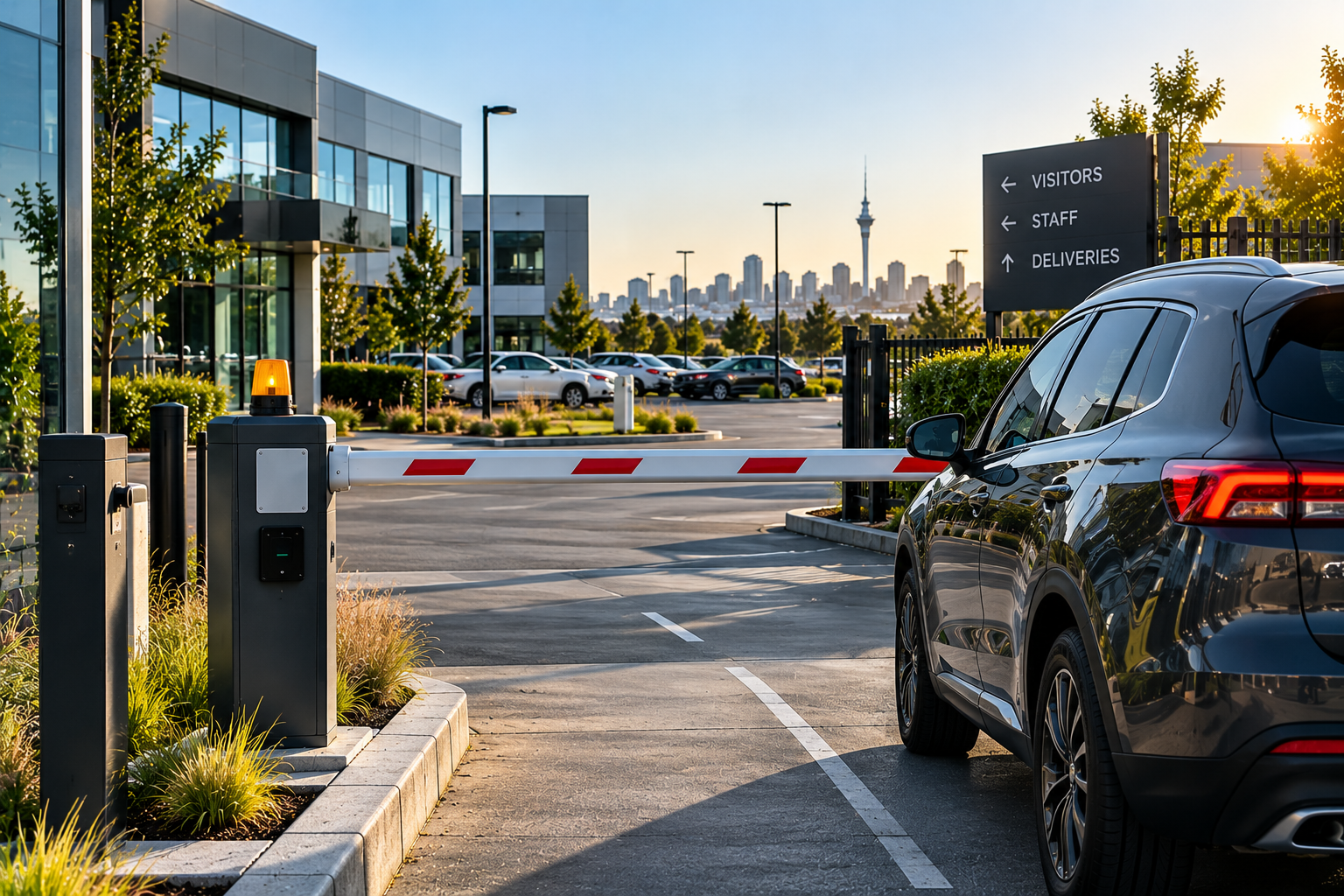
A barrier arm is a motorised pole that lifts to let a vehicle through and lowers to stop the next one. That simple action is what makes it so useful. Instead of relying on a sign that says “authorised vehicles only”, you have a physical checkpoint that every vehicle has to deal with. Only vehicles with the right credentials, or approved by someone on site, get through.
For businesses managing a steady flow of vehicles, this is a very practical form of vehicle access control. It is fast to operate, it takes up very little space compared to a full gate, and it can be added to an existing entrance without major changes to the surrounding property.
One of the most common problems we hear about from Auckland businesses is unauthorised parking. Shared commercial areas, retail centres, and business parks near the city or busy transport links often have people using private car parks as free parking. That takes spaces away from staff and customers, and it creates real frustration for tenants who pay for parking.
A barrier arm solves this directly. Because the arm only lifts for approved vehicles, there is no confusion about who is allowed in. You are not relying on someone to challenge strangers or on a parking warden to walk the site. The system does the checking every single time.
Many people assume a barrier will slow things down. In practice, a well set up barrier arm usually does the opposite. Without any control, a busy entrance can become messy, with vehicles stopping at random, queuing across the footpath, or blocking each other in and out.
A barrier arm creates a clear lane and a clear rhythm. Vehicles approach, the arm lifts, they drive through, and the arm closes behind them. When it is paired with automatic triggers such as a card reader, remote, or number plate recognition, regular users do not even need to stop. That makes it well suited to workplaces with a lot of vehicle movement at shift changes or peak hours.
How the arm gets its instruction to lift matters just as much as the arm itself. Businesses can choose a setup that matches how their site actually runs.
Most Auckland businesses end up combining two or three of these, for example, cards for staff and an intercom for visitors. Pairing a barrier with a proper access control system is what turns it from a simple lifting pole into something that genuinely manages who comes and goes.
A single entrance often has to handle very different types of vehicle. Staff arrive daily and expect no delays. Visitors need to be checked and directed. Delivery drivers want to be in and out quickly, and sometimes need access to a loading area rather than the main car park.
A barrier arm setup can handle all of these groups without them getting in each other’s way. Staff credentials can open the arm instantly, visitors can be let in through an intercom, and delivery vehicles can be directed to a separate lane or time window. That level of order is difficult to achieve with an open driveway and a few signs.
Controlling vehicle access is not only about security. It also affects safety. An uncontrolled entrance can mean vehicles entering at speed, cutting across pedestrian paths, or arriving at the same time as people walking to their cars.
A barrier arm naturally slows vehicles as they approach, and it creates one defined point where entry happens. Properly installed barrier arms include safety sensors that detect a vehicle or person in the arm’s path, so the arm does not lower onto anything underneath it. For workplaces with foot traffic, such as warehouses, clinics, or shared commercial buildings, that controlled approach reduces the chances of accidents near the entrance.
The same equipment gets used in quite different ways depending on the type of site.
Business parks and shared commercial buildings. Tenants and their staff get dedicated access while visitors are checked at the entrance. This keeps shared parking available for the people who actually need it.
Warehouses and light industrial sites. Barrier arms manage trucks, vans and staff vehicles entering the yard, and can be linked to staff-only or contractor-only credentials.
Medical centres and clinics. Controlled entry helps keep parking for patients and staff, particularly in busy suburbs where nearby street parking is limited.
Retail and hospitality car parks. Barrier arms can be used to restrict access during closed hours or to keep a car park private for customers and staff.
Residential complexes and apartment buildings. Many managers use barrier arms to keep resident and visitor parking organised, with intercom systems linking back to individual units.
It is worth being clear about the limits, so you choose the right system. A barrier arm controls vehicle access through a lane. It does not stop someone on foot from walking around it, and it is not designed to resist a determined attempt to force a vehicle through.
If your site needs full perimeter security, for example, if you store valuable stock or equipment overnight, then a barrier arm works best as part of a layered setup. Many businesses use a barrier arm for daytime traffic management and add commercial gates or fencing to secure the site after hours. Being honest about what you actually need from your entrance is the best way to avoid paying for the wrong thing.
One reason barrier arms are popular with Auckland businesses is how easily they adapt to existing layouts. They have a small footprint, so they can often be installed at entrances where there is not enough room for a swinging or sliding gate.
That said, a few things need to be checked before installation. The width of the lane, the direction of traffic, the position of the nearest road, and how far back vehicles can queue without blocking the street all affect where the arm should go. A good installer will look at how traffic really moves on your site, not only at where there happens to be a space for a post.
Barrier arms at busy sites can open and close hundreds of times a day, so reliability matters. Like any moving equipment, they perform best with regular attention. Sensors need checking, moving parts need lubricating and inspecting, and the control system should be tested so small faults do not become full breakdowns.
A scheduled maintenance and servicing plan is the easiest way to avoid a barrier that sticks closed during the morning rush or stays open when it should not. For businesses that rely on their entrance every day, preventing downtime is far cheaper than dealing with it after it happens.
Before choosing a system, it helps to answer a few simple questions.
Once you have those answers, the right barrier arm and access method becomes much easier to choose. If you are not sure, the quickest route is a site visit, where an installer can look at your entrance, watch how traffic moves, and recommend a setup that fits.
Q1. Will a barrier arm slow down staff arriving at busy times?
Not if it is set up properly. When it is paired with remotes, cards, or vehicle detection, regular users can drive through without stopping fully, and the arm lifts as they approach. The goal is to keep traffic moving while still checking who is entering.
Q2. How do visitors get in when a barrier arm is installed?
Most businesses use an intercom or call point that connects to reception or a security team. The person on site can see who is arriving and lift the arm remotely. Some sites also use temporary codes or pre-registered visitor lists.
Q3. Can a barrier arm stop people walking into my property?
No. A barrier arm manages vehicle entry only. If you also need to control pedestrian access, it can be combined with a separate pedestrian gate, turnstile, or fencing depending on the layout of your site.
Q4. Is a barrier arm suitable for a small business car park?
Yes, in many cases. Barrier arms are compact, so they suit smaller entrances where a full gate would be too large. They work well for staff car parks, small business parks, and sites where the main goal is keeping unauthorised vehicles out.
Q5. What happens to a barrier arm if the power goes out?
This depends on the system and how it is set up. Many installations include a manual release or battery backup so the arm can be lifted or kept operating during a power cut. It is worth discussing this during planning so you know exactly how your entrance behaves in an outage.
Q6. How often does a barrier arm need servicing?
That depends on how many vehicles use it each day. A high traffic entrance needs more frequent checks than a quiet one. Regular servicing keeps the sensors, motor and safety features working properly and helps prevent unexpected breakdowns.