Blog
There are plenty of gate companies out there — but very few that combine technical expertise, quality workmanship, and genuine customer care.
Walk into the lobby of an older Auckland office building and you will often find the same setup: a front desk, a sign-in book or tablet, and a door that may or may not be locked depending on the time of day. It works, up to a point. But as more businesses move to hybrid schedules, share floors with other tenants, and take building security more seriously, a growing number of offices are looking at automated turnstile entry as a better way to manage who comes and goes. Here is why, and what to think about before making the change.
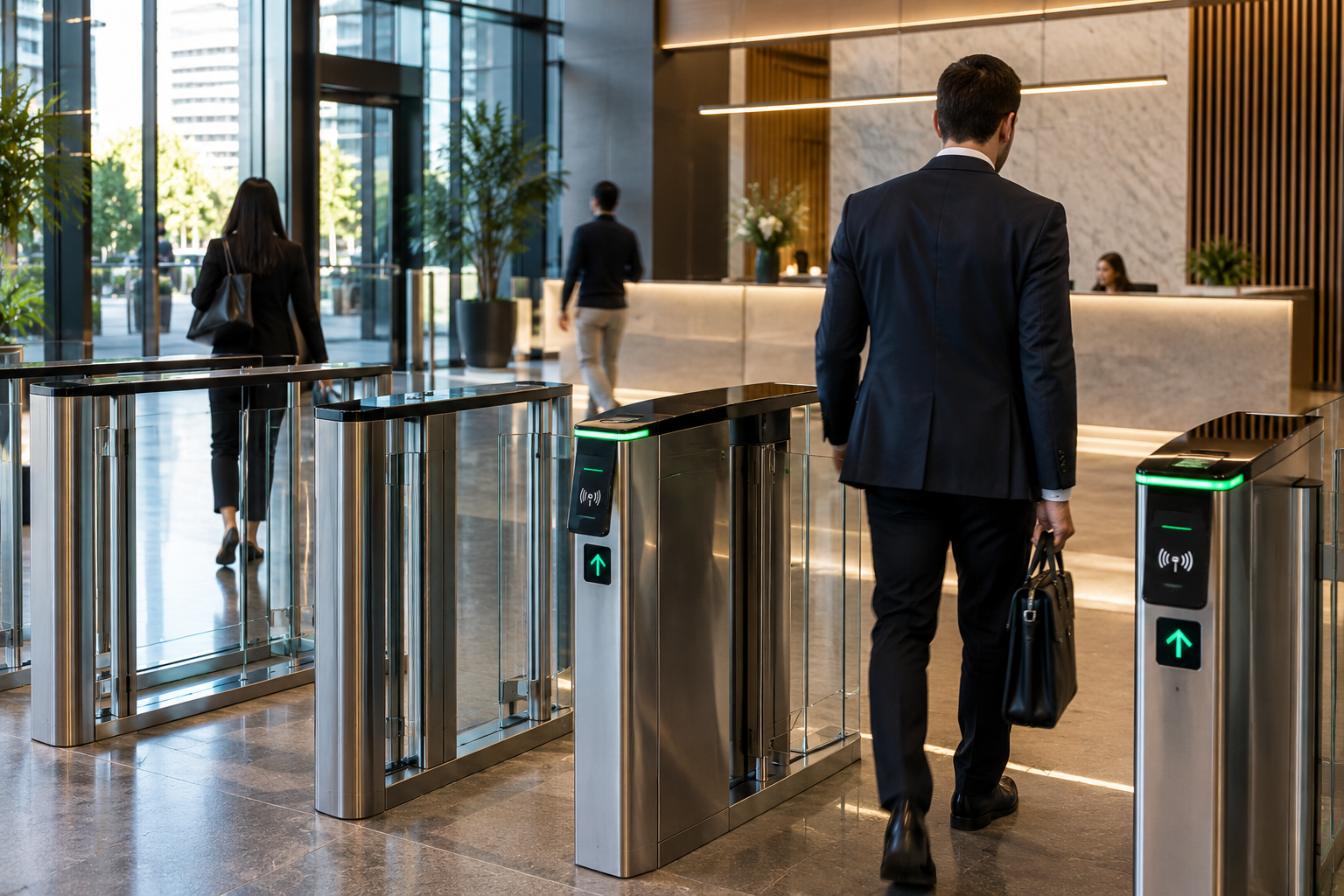
An automated turnstile is a controlled pedestrian entry point. Instead of a standard door, people pass through one at a time, and the turnstile only releases when it receives a valid credential, such as a card, fob, mobile credential, or a code. If the credential is not valid, the turnstile stays locked.
That sounds simple, but it changes how a building entrance works. Rather than relying on a receptionist to notice who walks past, or on people to remember to close a door behind them, the entrance itself enforces the rule. You can see the options available on our turnstile entry systems page.
Most office security problems are not dramatic. They are small, everyday gaps. Someone holds a door open for the person behind them. A contractor is let in and never signed out. A former employee’s key card still works three weeks after they left. A delivery driver wanders up to a floor they were never meant to visit.
A standard door with a card reader only checks the person who swipes. It does nothing about the person walking in behind them, which is known as tailgating. Turnstiles close that gap because only one person can pass per valid credential. For offices where tenants share a lobby, or where certain floors hold sensitive information, this one-person-per-credential rule makes a real difference.
Many Auckland workplaces no longer have the same people in the same seats every day. Hybrid schedules mean staff come and go on different days, teams rotate through shared desks, and visitors and contractors may outnumber regular staff on some days.
That makes the old method of recognising faces at reception much less reliable. A receptionist cannot be expected to know every person who might be authorised to enter on a given day. Automated entry shifts the job from “does this person look familiar?” to “does this person have valid access right now?” It is a more consistent way to run a building when attendance is no longer predictable.
Automated turnstiles connected to an access control system record every entry. That creates a log of who entered, at what time, and through which entry point.
This can be useful for several practical reasons.
The data is only as useful as how it is handled, so it is worth deciding upfront who can view the logs and how long they are kept, in line with your privacy obligations.
Different people need different levels of access. Permanent staff may need entry at all hours. Part-time staff may only need access on certain days. Visitors might need a single-day pass, and tenants in a shared building should only reach their own floor or suite.
With a turnstile connected to credential management, each of these can be handled through settings rather than through physical keys. When a staff member leaves or a tenant moves out, their access can be switched off immediately, with no need to change locks or recall keys. For building managers dealing with regular tenant changes, that saves a lot of administrative effort.
A common worry is that turnstiles make a lobby feel cold or industrial. In practice, that depends on the type of turnstile and how it is integrated into the space. There are options ranging from compact, discreet units that suit a corporate lobby to more robust designs for high traffic or outdoor areas.
Visitors still check in at reception in most office setups. The difference is that once they have been welcomed and issued a temporary credential, they enter through the same controlled point as everyone else. Many businesses find this actually feels more organised, because the entrance clearly signals that the building is managed and secure.
Another concern is whether turnstiles slow people down at busy times, such as the morning start or after lunch. A well planned setup should not. The number of lanes, the type of credential, and the speed of the reader all affect throughput.
For larger offices, multiple lanes can be installed side by side, with one lane set aside for wider access when needed. Credentials that can be read quickly, such as cards or mobile credentials, keep movement smooth. It helps to look at how many people typically arrive in the busiest ten minutes of the day, then plan lane numbers around that figure rather than the daily average.
Any pedestrian entry point has to work for everyone, including people using wheelchairs, pushing prams, or carrying large items. Most turnstile installations include a wider accessible lane or gate alongside the standard turnstile units so that access is not limited to those who can pass through a narrow lane.
Emergency exit is equally important. Turnstiles need to release or open in the event of a fire alarm or emergency so that people can leave quickly. Requirements around means of escape are set by the building’s design and the relevant regulations, so this should be planned together with the building owner, the fire engineer or building consultant, and your installer well before anything is installed.
For offices with their own car park or shared parking areas, the pedestrian entrance is only half the picture. Many sites combine turnstiles at the building entrance with a barrier arm at the car park entry. Staff and tenants can use a single credential for both, so the same card that lifts the barrier also opens the turnstile.
This gives building managers one connected system rather than separate ones for cars and people. It also reduces the number of cards, fobs, and codes that staff have to carry and the number of systems an administrator has to maintain.
Turnstiles at an office entrance get used constantly. Every person who enters or leaves passes through them, so wear and tear builds up quickly. Sensors need to stay calibrated, moving parts need regular inspection, and the software connecting the turnstile to your credentials needs to stay up to date.
Without regular servicing, small faults tend to appear at the worst possible time, like the Monday morning rush. A scheduled maintenance plan keeps the entrance running reliably and picks up issues before they turn into breakdowns.
Turnstiles are not the right answer for every workplace. A small office with a handful of staff and no shared lobby may be well served by a good door lock and card reader. A building with multiple tenants, a busy lobby, sensitive areas, or a need for accurate entry records is where turnstiles tend to make the most sense.
A few questions help clarify the decision.
If most of these apply, it is worth having a site assessment so the layout, lane numbers, and access setup can be matched to your building.
Q1. What is the difference between a turnstile and a standard card reader door?
A card reader door checks the credential of the person who swipes, but it cannot stop another person from following them through. A turnstile only allows one person to pass for each valid credential, which makes tailgating much harder.
Q2. Will turnstiles cause queues during busy periods?
Not if the entrance is planned correctly. The number of lanes and the type of credential used both affect speed. Planning around your busiest ten minutes, rather than an average day, helps keep movement smooth.
Q3. How do visitors get through a turnstile?
Visitors usually check in at reception and are issued a temporary credential, such as a visitor card or a time-limited code. Some offices also use a staffed accessible gate so reception can let visitors through directly.
Q4. Are turnstiles accessible for wheelchair users and people with prams?
Most installations include a wider accessible lane or gate alongside the standard units. This should be part of the design from the start so that everyone can use the entrance comfortably.
Q5. What happens to the turnstile in an emergency or power cut?
Turnstiles need to allow people to exit safely during emergencies such as a fire alarm. How this works depends on the building’s design and the relevant requirements, so it should be planned with the building owner and an appropriate fire or building professional before installation.
Q6. Can turnstiles be linked to the car park barrier and other access control?
Yes, in many cases. The same credential can be used for car park barrier arms, turnstiles, and internal doors, which simplifies administration for staff and building managers.